
You're walking down a street in Japan when every phone around you — yours, the stranger's next to you, the convenience store clerk's — screams the exact same jarring alarm at once. It's not your ringtone. It's not a normal notification sound. It's a harsh, deliberately dissonant siren, and for a second your stomach drops.
You look at the screen. It's covered in Japanese text you can't read, and the alert tone alone is enough to make you think something is seriously wrong.
Here's the short version: nine times out of ten, this is not a real earthquake — it's a scheduled disaster drill. This post walks through an actual alert screen, explains what the system is, whether it ever shows up in English, and why the sound is engineered to be this unsettling.
The system behind that alert
Japan runs a nationwide cell-broadcast system called Emergency Bulletin Mail (緊急速報メール), sometimes called Area Mail (エリアメール). Carriers push it to every phone connected to towers in a defined area — it doesn't matter if you're on a Japanese SIM, roaming on a foreign number, or using a rental pocket wifi paired with your own phone. If you're physically in the broadcast zone, your phone gets the alert, which is exactly why it hit you, the person next to you, and the store clerk all at the same second.
The system fires for three distinct reasons:
- Earthquake Early Warning (緊急地震速報) — a genuine warning that strong shaking is expected to arrive in seconds
- J-Alert (国民保護情報) — tsunami warnings, missile alerts, severe weather warnings, and other national-level emergencies
- Scheduled disaster drills (訓練) — local governments running planned exercises, once or twice a year. This is what most travelers who search for this actually experienced.
What an actual alert looks like
The screenshots below are from a real alert — Osaka Prefecture's annual "880-Man-Nin Kunren" (880万人訓練, literally the "8.8 Million People Drill"), a large-scale disaster exercise that's been run every year since 2012. 2026 marks its 15th iteration. It goes out prefecture-wide at 10:00 a.m. every September 1st — Japan's official "Disaster Prevention Day" (防災の日), commemorating the anniversary of the 1923 Great Kanto Earthquake.
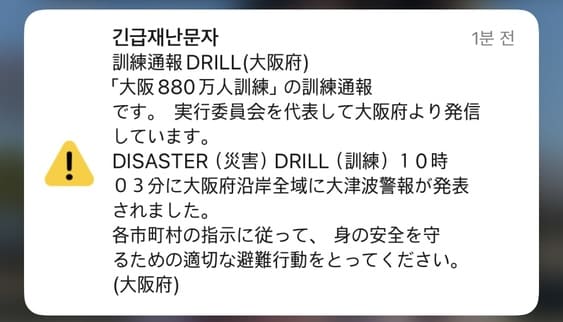 The lock screen banner reads "訓練通報 DRILL(大阪府)" — "Training Notification DRILL (Osaka Prefecture)."
Tapping it opens the full message:
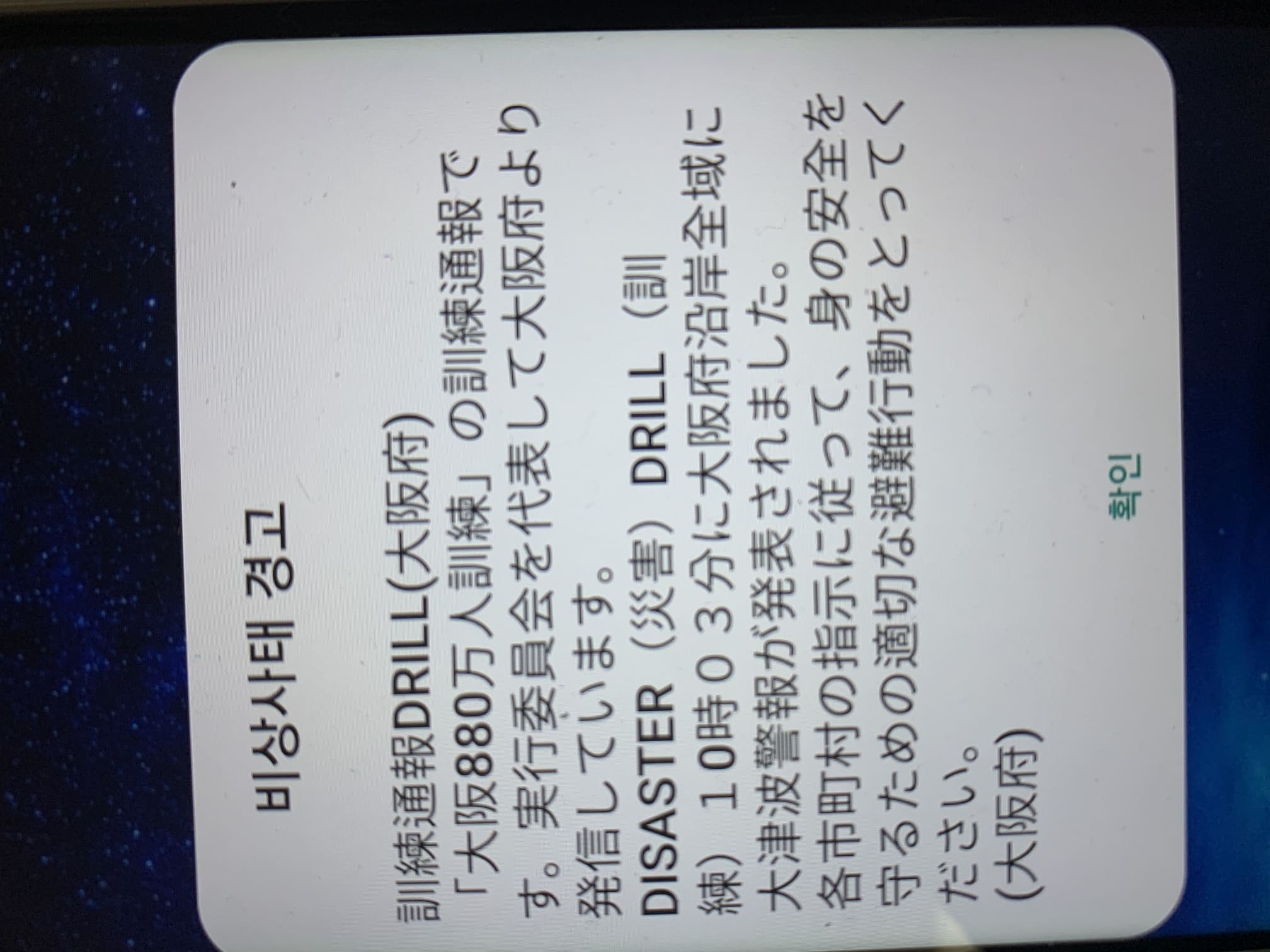 The body clearly states "DISASTER(災害)DRILL(訓練)," followed by a drill scenario describing a major tsunami warning issued along Osaka's entire coastline.
The one thing to actually check: the word 訓練 or DRILL will always appear near the start or end of the message. A genuine emergency alert never includes that word.
Does it come in English? — Fact-checked
This is the question most people actually want answered.
The notification title and buttons — things like "Emergency Alert" or "OK" — can appear in your phone's own display language. That's not the Japanese government translating anything for you; it's just your phone rendering its own system UI in whatever language you have your device set to. Android and iOS both localize the chrome around these emergency alerts automatically, regardless of who sent them.
The actual message body, however, defaults to Japanese. In the real screenshots above, the title UI happens to render in the phone owner's system language, but the substantive sentence — "訓練通報で「大阪880万人訓練」の訓練通報です…" — is entirely in Japanese. That said, more municipalities are now embedding key English words like "DRILL" and "DISASTER" directly into the body text, so even without reading Japanese, you can usually infer that it's a drill.
| Component | Language |
|---|---|
| Alert title / buttons (system UI) | Follows your phone's own language setting |
| Warning message body | Japanese by default (key English words sometimes included) |
If you want emergency information you can actually read in full, install Safety tips, the free official app from Japan's tourism agency (JNTO). It supports 14 languages and delivers fully translated earthquake, tsunami, and weather alerts.
Why it sounds this frightening
That siren wasn't an accident — it was engineered to unsettle you.
Japan's earthquake early warning tone was composed in 2007 by Takashi Kokubo (小久保隆), on commission from NTT Docomo. The brief itself was blunt: create a sound "intense enough to wake someone from sleep." To meet it, the design deliberately used:
- Dissonant intervals the brain can't process as an ordinary, ignorable sound
- A rapidly rising siren tone — the same principle used in ambulance sirens and air-raid alarms, built to be nearly impossible to miss anywhere you are
- A three-time repeat to make sure it registers even if you miss it the first time
So feeling startled is the intended reaction, not a malfunction. It's engineered to trigger an instinctive alert response — if it made your heart jump, the sound did exactly what it was designed to do.
What to actually do right now
If 訓練 or DRILL appears anywhere in the message → do nothing. Carry on with what you were doing.
If you feel actual shaking and don't see 訓練 or DRILL → this is likely a genuine Earthquake Early Warning. Head to the Japan Earthquake Safety Guide for a full breakdown of what to do by intensity level and location.
If you're unsure, watch the locals around you. If everyone keeps walking and talking, it's almost certainly a drill. If people are ducking, covering their heads, or getting under tables, treat it as real.
This isn't specific to any one city, by the way — the example above happens to be from Osaka only because that's the alert that was received while researching this. Local governments across Japan — Tokyo, Nagoya, Fukuoka, and others — run their own scheduled drills on their own dates. Wherever you're traveling in Japan, you can get one of these.
30-second pre-trip checklist
- Regardless of your phone's language setting, check the alert body text for 訓練 or DRILL first
- Install Safety tips, JNTO's official app (14 languages including English, free)
- If you're traveling around September 1st (Disaster Prevention Day), expect a higher chance of receiving a large-scale drill alert
- When in doubt, check how the people around you are reacting
Related guides